Difference between revisions of "Milking Parlour"
Fiorecastro (talk | contribs) |
|||
| (5 intermediate revisions by 2 users not shown) | |||
| Line 1: | Line 1: | ||
| + | {{OpenPagesTop}} | ||
Also known as: '''''Milking Machine | Also known as: '''''Milking Machine | ||
| Line 67: | Line 68: | ||
Most parlours are fitted with Automatic Cluster Removal apparatus. The milk machine detects when the milk flow rate falls to a pre-set “take-off” level (usually between 200 and 400 ml/minute). When this occurs, this triggers a cord to be retracted which is attached to the claw piece of the cluster. This pulls the cluster off the cow. | Most parlours are fitted with Automatic Cluster Removal apparatus. The milk machine detects when the milk flow rate falls to a pre-set “take-off” level (usually between 200 and 400 ml/minute). When this occurs, this triggers a cord to be retracted which is attached to the claw piece of the cluster. This pulls the cluster off the cow. | ||
| − | The advantages of the ACR is the prevention of over milking (which can cause teat damage and thus increased mastitis levels) and time efficiency for the parlour operator. However it must be remembered that the prevention of over milking is dependent on the take-off setting and therefore over milking can still be a problem in herds using ACRs. The disadvantages of using ACRs are that there may be more of a delay between milking and [[Post-Milking Teat Disinfection | + | The advantages of the ACR is the prevention of over milking (which can cause teat damage and thus increased mastitis levels) and time efficiency for the parlour operator. However it must be remembered that the prevention of over milking is dependent on the take-off setting and therefore over milking can still be a problem in herds using ACRs. The disadvantages of using ACRs are that there may be more of a delay between milking and [[Post-Milking Teat Disinfection|post milking teat disinfection]], and occasionally premature cluster take-off will occur such as when bimodal milk flow is a problem. |
==Parlour washing== | ==Parlour washing== | ||
| Line 140: | Line 141: | ||
===Rotary=== | ===Rotary=== | ||
| − | Rotary parlours are good for large herds due to the large throughput of cows possible. Cows may face the inside ('''external rotary''') or outside ('''internal rotary''') of the circle depending on the particular design. For a large rotary there should be at least three operators for an effective milking routine. One for udder preparation, the second for unit attachment and the third for [[Post-Milking Teat Disinfection | + | Rotary parlours are good for large herds due to the large throughput of cows possible. Cows may face the inside ('''external rotary''') or outside ('''internal rotary''') of the circle depending on the particular design. For a large rotary there should be at least three operators for an effective milking routine. One for udder preparation, the second for unit attachment and the third for [[Post-Milking Teat Disinfection|post milking teat disinfection]]. |
[[File:Rotary parlour.JPG|thumb|250px|center|External Rotary Parlour]] | [[File:Rotary parlour.JPG|thumb|250px|center|External Rotary Parlour]] | ||
| Line 164: | Line 165: | ||
A static test is performed when cows are not present in the parlour. It involves measuring the vacuum level in various parts of the machine, calculating the vacuum reserve, ensuring adequate vacuum pump function and ensuring adequate pulsation (with a suitably long massage phase to ensure teat health). | A static test is performed when cows are not present in the parlour. It involves measuring the vacuum level in various parts of the machine, calculating the vacuum reserve, ensuring adequate vacuum pump function and ensuring adequate pulsation (with a suitably long massage phase to ensure teat health). | ||
| − | + | ===Dynamic Tests=== | |
Dynamic tests are performed when cows are being milked. The main aim is to measure vacuum fluctuations at the teat end which may not always be suggested as a problem by the results of the static test. Milk flow can also be measured which may reveal problems with bimodal milk flow, suggestive of problems with udder preparation and/or milk let down. It is during such tests that '''liner slip''' may be noticed. | Dynamic tests are performed when cows are being milked. The main aim is to measure vacuum fluctuations at the teat end which may not always be suggested as a problem by the results of the static test. Milk flow can also be measured which may reveal problems with bimodal milk flow, suggestive of problems with udder preparation and/or milk let down. It is during such tests that '''liner slip''' may be noticed. | ||
| Line 173: | Line 174: | ||
File:Dynamic milk testing 2.JPG | File:Dynamic milk testing 2.JPG | ||
</gallery></center> | </gallery></center> | ||
| − | |||
==References and Further Reading== | ==References and Further Reading== | ||
| Line 182: | Line 182: | ||
| − | {{ | + | {{Nick Lyons written |
| − | + | |date = July 18, 2011}} | |
| + | |||
| + | ==Webinars== | ||
| + | <rss max="10" highlight="none">https://www.thewebinarvet.com/herd-health/webinars/feed</rss> | ||
| + | |||
| + | [[Category:Dairy Cow Management]] | ||
Latest revision as of 20:39, 3 January 2023
Also known as: Milking Machine
Introduction
The modern milking parlour was first developed in the 1800’s using the concept of an alternating vacuum to milk cows. Its development has played a massive part in the growth and intensification of the dairy industry with automation bringing labour efficiency and the ability to keep large numbers of dairy cows on one farm.
Knowledge of parlour function and the common problems seen is essential in order to understand its role as a possible risk factor for mastitis and is therefore firmly within the remit of a veterinary surgeon’s role on dairy farms.
Correct maintenance of the milk machine is a component of the five point plan.
There are several components to the milking parlour to fulfil three necessary objectives:
- Delivery of a vacuum to transfer milk from the udder to the bulk tank
- Delivery of a vacuum to the pulsation chamber of the cluster
- Effective parlour washing and cooling of the milk in order to prevent the build up of bacteria
How the Milk Machine Works
The milk machine works by having a collapsible liner within a solid pulsation chamber. The liner forms a seal at the top of the teat and connects with the short milk tube to deliver milk to the claw piece of the cluster. Via the short pulsation tube, the pulsation chamber has an alternating vacuum/atmospheric air delivered which causes the milk liner to open and close beneath the level of the teat. When vacuum is present within the pulsation chamber, there is an equal pressure with that in the short milk tube, which has a constant vacuum supply to facilitate movement of milk away from the udder. The equal pressures means the liner is open and milk is drawn out. Conversely when atmospheric air is introduced into the pulsation chamber, the pressure differential causes the liner to collapse and the teat no longer to be exposed to the vacuum. This allows blood flow to return to the teat necessary to prevent teat damage and is called the massage phase. A constant vacuum applied to the teat, as in the early parlour designs, causes a vast amount of soft tissue trauma which would cause untold levels of mastitis.

Movement of Milk
All four short milk tubes meet at the claw piece, and from there the milk mixes and goes into the long milk tube. All the long milk tubes from each individual cluster contribute to the milk transfer line which delivers the milk to the receiver vessel. Some parlours may have more than one receiver vessel. The location of the milk transfer line is important as this determines the vacuum level required to move the milk. In a low line parlour, the milk transfer line runs below the level of the udder and requires a lower vacuum level of 38-40kPa. This compares to a high line parlour which has the milk transfer line above the level of the udder. In this scenario, extra energy is required to lift the milk to this level so a greater vacuum is required at somewhere around 46-50kPa. Once the milk reaches the receiver vessel, often another smaller vacuum pump is present known as a milk pump to transfer the milk from the receiver vessel to the bulk tank. This pump is triggered when the milk level in the receiver vessel reaches a pre-determined height.


Vacuum Pump and Interceptor
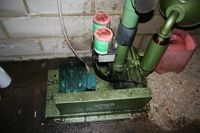
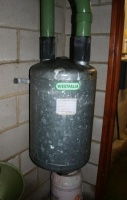
A vacuum pump works by extracting air from the system at a constant rate in order to create the vacuum. A critical aspect of the machine design is the integration of a vacuum to both the pulsation tubes (which should never contain milk) and the milk pipes to facilitate flow from the udder to the bulk tank. However, it is critical that no liquid reaches the vacuum pump which would damage it. The interceptor vessel is present near the vacuum pump to act as a safeguard to prevent any liquid matter reaching the pump.
- Vacuum pump and interceptor


Vacuum Reserve
Vacuum reserve is the amount of extra vacuum generated by the pump so that when air enters the system a stable vacuum is maintained. If air does not enter the system, the regulator lets air in so vacuum levels do not increase (see section on the regulator below). Inadequate reserve can lead to vacuum fluctuations in the system which is a risk for mastitis. Additionally liner slip or units falling off cows during milking may be seen. The vacuum reserve is regularly measured as part of a static parlour test.
Sanitary Trap
The sanitary trap is where the vacuum and liquid systems meet. The main vacuum line from the vacuum pump supplies the sanitary trap and from it leaves pipes that go to the pulsation chambers in the clusters and receiver vessel of the milk system. A ball is present so that if the sanitary trap inadvertently fills up with milk, the ball floats to the top and closes off the vacuum supply. This is to try to prevent any milk reaching the vacuum pump. The sanitary trap is usually clear and located in the parlour so the operator can see if it is filling up with milk which puts the whole plant at risk of failure if the milk reaches the pulsation or main vacuum system.

Regulator
The regulator is a valve present on the vacuum system to try to maintain a constant vacuum level in the system. Air is extracted at a constant rate by the vacuum pump. Normally, air enters the system from various parts of the milking machine such as when the clusters are attached to the cow’s udder. If the vacuum reaches a certain level, the regulator valve will open to let air into the system to maintain vacuum stability. When air is entering the system from other parts of the machine, the regulator will have to extract relatively less to maintain this stability. Air enters via filters which need to be regularly cleaned in order for the regulator to function correctly and prevent excess particulate matter entering the vacuum system. Occasionally the source of the air may be outside the building to reduce the amount of matter entering the system – a so called clean air system.
During milking, the regulator should be constantly heard to be letting air into the system. Failure to do so may be indicative of an inadequate vacuum reserve or a problem with the regulator.
Optimal function of the regulator is vital, since an unstable vacuum can lead to vacuum fluctuations at the teat end which increases the risk of mastitis.
Teat Liners
The teat liner is the only part of the parlour that has direct contact with the cow and is therefore a potentially very important fomite for spread of mastitis pathogens. The more liners are used, the more they get worn. Cracks may appear which may harbour pathogens. Additionally, the elasticity of the liner is also affected which can be detrimental to teat health. Therefore it is important that liners are changed at sufficient time periods. The liner life depends on the type of liner with rubber liners lasting 2,500 milkings (or 6 months, whichever is sooner) whilst silicone liners last 10,000 milkings. Rubber liners are more widely used, whilst silicone liners are more expensive. Various designs of liner are available on the market (e.g. triangular). Some parlours require specific liner types such as those that have an ADF system installed.
Automatic Cluster Removal (ACR)
Most parlours are fitted with Automatic Cluster Removal apparatus. The milk machine detects when the milk flow rate falls to a pre-set “take-off” level (usually between 200 and 400 ml/minute). When this occurs, this triggers a cord to be retracted which is attached to the claw piece of the cluster. This pulls the cluster off the cow.
The advantages of the ACR is the prevention of over milking (which can cause teat damage and thus increased mastitis levels) and time efficiency for the parlour operator. However it must be remembered that the prevention of over milking is dependent on the take-off setting and therefore over milking can still be a problem in herds using ACRs. The disadvantages of using ACRs are that there may be more of a delay between milking and post milking teat disinfection, and occasionally premature cluster take-off will occur such as when bimodal milk flow is a problem.
Parlour washing
Correct cleaning of the milk machine is important to prevent the build up of bacteria in the bulk milk tank. Failure to remove all milk residues and achieve adequate sterilisation will lead to bacterial multiplication that may raise the bulk milk Bactoscan level.
Parlour washing is initiated by connecting the clusters to the jetters located by each milking unit. Within the parlour, the wash pipes are often plastic to help distinguish them from the stainless steel milk lines.

There are two broad types of parlour washing routine:-
Circulation cleaning
Circulation cleaning is the usual method of parlour washing in the UK. The generally recommended circulation wash routine has three components:-
- Warm rinse
- The first rinse should consist of warm water. If cold water is used, fatty residues tend to congeal onto the inner surface of the pipes which is more difficult to remove and will encourage bacterial replication. In addition the system will be cooled prior to the hot wash which will mean the hot water gets cooler quicker and less effectively clean the parlour. The aim of the warm rinse is to remove the bulk of the milk residues. The water is usually run to waste and should be continued until visibly clear.
- Hot wash
- This consists of hot water (70-90°C) containing a detergent/ disinfectant that is circulated around the parlour. The temperature of the water should not fall below 40°C or fat may congeal and line the pipes. This final temperature can be measured at the end of the circulation wash as part of an investigation into a high Bactoscan level. As a subjective assessment it should not be possible to hold onto the milk transfer line during the circulation due to the high temperature conducted through the stainless steel pipes. The hot wash lasts approximately 5-8 minutes.
- Cold water rinse
- This last step is to remove any residual disinfectant from the hot wash.
With circulation cleaning, it is important that the entire pipe is disinfected. In order to achieve this, the wash solution needs to be agitated. This is facilitated by the use of air injectors which inject regular bursts of air to cause the agitation. Air injectors help ensure the entire surface of the pipe is covered and make parlour washing more effective.
Circulation cleaning is often performed semi-automatically.
Acid Boiling Wash
There is no circulation wash with this method, with large volumes of very hot water containing disinfectant and detergent chemicals being run directly to waste. This method uses less chemical than circulation washing and is faster, but due to the requirement for large volumes of boiling water a large boiler capacity is required.
Milk cooling
It is of great importance that milk is cooled as soon as possible to limit bacterial overgrowth. This is facilitated by the use of a plate cooler. The plate cooler is placed between the receiver vessel and bulk tank and cools the milk so that when it enters the bulk tank, it is close to the storage temperature of 4°C. Using a counter current mechanism, cold water runs in the opposite direction to the flow of milk and heat is transferred from the milk to the water. The surface area is maximised to increase the efficiency of this process by the use of several stainless steel plates separating the milk and water. Once in the bulk tank, the temperature is maintained at 4°C ready for collection by the dairy milk tanker.

Types of parlour
The common types of parlour available include:
Herringbone
Herringbone is the most common type of parlour seen in the UK. Cows face at a slight angle to the milker who is located in a “pit” between two lines of cows. The milker has good access to the cow’s udder with this system being at the level of the waste/chest region. One disadvantage is that a cow that is slow to milk out delays the release of the rest of the cows in the line.
In this system, there can either be one milking unit per cow position, or one unit which is shared between the two lines. The latter is known as a swingover parlour. Although cheaper to install due to fewer units required, this type of parlour is slower to operate. Usually longer parlours are necessary with this setup. Both of these systems can also be seen in rapid exit parlours (below).
Trigon
Trigon parlours are similar to the herringbone design except that there are three rows of cows arranged in a triangle shape.
Rapid exit
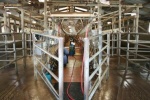
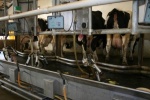
In rapid exit parlours, the layout is similar to a herringbone parlour. Cows face at a more perpendicular angle to the milker compared to a herringbone. At the end of milking, a bar is either raised or lowered in front of the cows to allow the whole line to exit simultaneously. As with the herringbone, there is a problem with cows that are slow to milk out.
- Rapid Exit Parlour


Tandem
In tandem parlours, cows are located parallel to the milking pit. Tandem parlours allow more individual attention to the cow, but are generally slow and only appropriate for smaller herds. However, where slow milkers are present, they do not delay the release of faster milking cows as is the case with herringbone/rapid exit/trigon parlours.

Abreast
In this system, cows stand alongside each other and have to climb onto a step (approximately 30-40cm high) after which a chain is secured behind them to keep them in place. The milker then has to bend over for udder preparation and unit attachment. This system usually has enough units to milk between 6 and 12 cows simultaneously. As for tandem parlours, this type of parlour is slow and tends to only be appropriate for smaller herds.
Rotary
Rotary parlours are good for large herds due to the large throughput of cows possible. Cows may face the inside (external rotary) or outside (internal rotary) of the circle depending on the particular design. For a large rotary there should be at least three operators for an effective milking routine. One for udder preparation, the second for unit attachment and the third for post milking teat disinfection.

Tie Stalls
In tie-stall barns, cows are tied up and have a space to lie. The milk line runs around the shed, and the milker moves to each cow in turn to do the milking. This system is quite common in parts of North America and Canada.
Robotic Milking
Robotic milking is a growing part of the industry due to its appeal in labour efficiency. Using laser technology, the unit is able to automate the whole milking process. Using an incentive of dairy concentrate feed, cows tend to use the robot on average more than twice a day and produce higher milk yields compared to twice daily milking as a consequence.
One unit costs somewhere in the region of £180,000 to £200,000 which will be enough for approximately 70 cows. Appropriate 24 hour available maintenance is important in case the unit breaks down.
Parlour Maintenance and Testing
Regular parlour testing and maintenance is crucial for correct function which is necessary to prevent mastitis. Parlours must be tested an absolute minimum of once a year although every six months is preferable. Part of the maintenance also involves regular changing of teat liners according to their use.
Milk machine maintenance is a component of the five point plan.
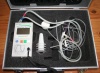
Static Tests
A static test is performed when cows are not present in the parlour. It involves measuring the vacuum level in various parts of the machine, calculating the vacuum reserve, ensuring adequate vacuum pump function and ensuring adequate pulsation (with a suitably long massage phase to ensure teat health).
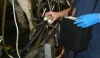
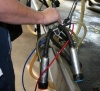
Dynamic Tests
Dynamic tests are performed when cows are being milked. The main aim is to measure vacuum fluctuations at the teat end which may not always be suggested as a problem by the results of the static test. Milk flow can also be measured which may reveal problems with bimodal milk flow, suggestive of problems with udder preparation and/or milk let down. It is during such tests that liner slip may be noticed.
- Dynamic Parlour testing


References and Further Reading
Biggs, A., 2009. Mastitis in Cattle, 1st Edition. The Crowood Press Ltd.
Blowey, R., Edmondson, P., 2010. Mastitis Control in Dairy Herds, 2nd Edition. CABI International.
 |
This article was written by Nick Lyons MA VetMB CertCHP MRCVS on July 18, 2011. |
Webinars
Failed to load RSS feed from https://www.thewebinarvet.com/herd-health/webinars/feed: Error parsing XML for RSS