Difference between revisions of "Dental Formula - Cat"
Jump to navigation
Jump to search
Fiorecastro (talk | contribs) |
|||
| (14 intermediate revisions by 3 users not shown) | |||
| Line 3: | Line 3: | ||
==Introduction== | ==Introduction== | ||
| − | Cats are toothless at birth. '''Deciduous''' teeth are complete and functional within 2 months of birth. '''Permanent''' teeth are complete and functional by the end of the 6th month. | + | Cats are toothless at birth. '''Deciduous''' teeth are complete and functional within 2 months of birth. '''Permanent''' teeth are complete and functional by the end of the 5th or 6th month. |
| − | + | The formula for '''deciduous''' teeth: 2 (I3/3 C1/1 P3/2) | |
| + | |||
| + | The formula for '''permanent''' teeth: 2 (I3/3 C1/1 P3/2 M1/1) | ||
| − | |||
===Incisors=== | ===Incisors=== | ||
| − | + | Sometimes a cat's lower '''incisor''' teeth are shed in middle age. | |
| − | |||
| − | |||
| − | |||
| − | |||
| − | |||
| − | |||
| − | |||
| − | |||
| − | |||
| − | |||
| − | |||
| − | |||
===Molars=== | ===Molars=== | ||
| − | |||
| − | |||
A decrease in the number of '''molars''' leaves the cat with a shearing bite, rather than wider cusps for grinding. | A decrease in the number of '''molars''' leaves the cat with a shearing bite, rather than wider cusps for grinding. | ||
| Line 35: | Line 22: | ||
Image:Aspinall Slide13.JPG|<small>Image from [http://www.elsevierhealth.co.uk/veterinary-nursing/spe-60136/ Aspinall, The Complete Textbook of Veterinary Nursing], Elsevier Health Sciences, ''All rights reserved''</small> | Image:Aspinall Slide13.JPG|<small>Image from [http://www.elsevierhealth.co.uk/veterinary-nursing/spe-60136/ Aspinall, The Complete Textbook of Veterinary Nursing], Elsevier Health Sciences, ''All rights reserved''</small> | ||
Image:Feline Dentition.jpg|Feline Dentition - Copyright Nottingham 2008 | Image:Feline Dentition.jpg|Feline Dentition - Copyright Nottingham 2008 | ||
| + | Image:Oral Cavity Cat.jpg|Teeth Cat - Copyrigh Copyright P.Fernandes | ||
</gallery></center> | </gallery></center> | ||
| − | {{ | + | {{OpenPages}} |
| − | |||
| − | |||
| − | |||
| − | |||
| − | |||
| − | |||
| − | |||
[[Category:Teeth - Anatomy & Physiology]] | [[Category:Teeth - Anatomy & Physiology]] | ||
[[Category:Cat - Alimentary System]] | [[Category:Cat - Alimentary System]] | ||
| − | [[Category: | + | [[Category:A&P Done]] |
| − | [[Category: | + | [[Category:Dentistry]] |
| − | [[Category: | + | [[Category:LisaM reviewing]] |
Revision as of 15:11, 10 June 2013
Introduction
Cats are toothless at birth. Deciduous teeth are complete and functional within 2 months of birth. Permanent teeth are complete and functional by the end of the 5th or 6th month.
The formula for deciduous teeth: 2 (I3/3 C1/1 P3/2)
The formula for permanent teeth: 2 (I3/3 C1/1 P3/2 M1/1)
Incisors
Sometimes a cat's lower incisor teeth are shed in middle age.
Molars
A decrease in the number of molars leaves the cat with a shearing bite, rather than wider cusps for grinding.
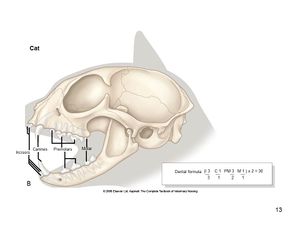
Image from Aspinall, The Complete Textbook of Veterinary Nursing, Elsevier Health Sciences, All rights reserved
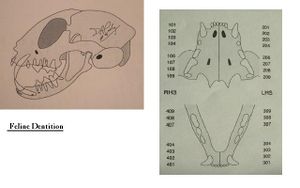
Feline Dentition - Copyright Nottingham 2008
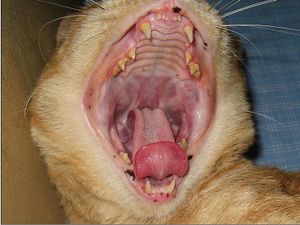
Teeth Cat - Copyrigh Copyright P.Fernandes


Error in widget FBRecommend: unable to write file /var/www/wikivet.net/extensions/Widgets/compiled_templates/wrt69a33d47995718_68479076 Error in widget google+: unable to write file /var/www/wikivet.net/extensions/Widgets/compiled_templates/wrt69a33d47a006a6_82298763 Error in widget TwitterTweet: unable to write file /var/www/wikivet.net/extensions/Widgets/compiled_templates/wrt69a33d47a520a5_68721581
|
| WikiVet® Introduction - Help WikiVet - Report a Problem |