Difference between revisions of "Dental Extraction Hand Instruments - Small Animal"
m (Text replace - "[[Enamel Organ#" to "[[Tooth - Anatomy & Physiology#") |
|||
| Line 3: | Line 3: | ||
==Luxators and Elevators== | ==Luxators and Elevators== | ||
| − | Luxators and elevators are used to cut or break down the [[ | + | Luxators and elevators are used to cut or break down the [[Tooth - Anatomy & Physiology#Periodontal Ligament|periodontal ligament]], which holds the [[:Category:teeth - Anatomy & Physiology|tooth]] in the alveolus. A selection of dental luxators and elevators of varying sizes are required so that an appropriate range for each size of root is available.<br><br> |
| − | '''Luxators''' have a very '''thin working end''' and are used to cut the gingival attachment and [[ | + | '''Luxators''' have a very '''thin working end''' and are used to cut the gingival attachment and [[Tooth - Anatomy & Physiology#Periodontal Ligament|periodontal ligament]], but should not be used for leverage as the metal at the tip is too thin and weak for this action. <br><br> |
| − | '''Elevators''' have '''thicker working ends'''. They are used to break down the [[ | + | '''Elevators''' have '''thicker working ends'''. They are used to break down the [[Tooth - Anatomy & Physiology#Periodontal Ligament|periodontal ligament]] with a combination of apical pressure and leverage. The tip of an elevator should form a sharp edge which can be rounded or square. Modified ends such winged elevators have extended sides and are also available. |
An extraction can be started with a luxator and completed with an elevator.<br><br> | An extraction can be started with a luxator and completed with an elevator.<br><br> | ||
A very small (2 mm) luxator, or a root tip elevator, will assist removal of fractured root tips and should be available for all extractions – just in case.<br><br> | A very small (2 mm) luxator, or a root tip elevator, will assist removal of fractured root tips and should be available for all extractions – just in case.<br><br> | ||
'''Periosteal Elevator:'''<br> | '''Periosteal Elevator:'''<br> | ||
| − | A periosteal elevator is required for open (surgical) extractions to expose the [[ | + | A periosteal elevator is required for open (surgical) extractions to expose the [[Tooth - Anatomy & Physiology#Alveolar Bone|alveolar bone]] by raising a mucoperiosteal flap. Different patterns are available but all have a spoon-like blade in line with the handle. The working side is flat with a concave curvature and the back side is rounded. The edge should be sharp and will need regular [[Dental Equipment Maintenance - Small Animal|sharpening]] as it is used against [[Bones - Anatomy & Physiology|bone]]. |
<br><br> | <br><br> | ||
'''Extraction Forceps:'''<br> | '''Extraction Forceps:'''<br> | ||
| − | Forceps are used to aid ligament breakdown by rotational force on the tooth. It is easy to snap the [[ | + | Forceps are used to aid ligament breakdown by rotational force on the tooth. It is easy to snap the [[Tooth - Anatomy & Physiology#Crown|crown]] off by using excessive force or if the tooth is not levered sufficiently. |
The forceps should grip the tooth firmly with '''four point contact'''. The best pattern for veterinary use is 76 and 76N. The pattern is almost straight with a slight offset of the beaks. The 76N has the same profile but with narrower beaks and is used to grip smaller teeth, for example cat teeth. | The forceps should grip the tooth firmly with '''four point contact'''. The best pattern for veterinary use is 76 and 76N. The pattern is almost straight with a slight offset of the beaks. The 76N has the same profile but with narrower beaks and is used to grip smaller teeth, for example cat teeth. | ||
Revision as of 13:18, 2 November 2014
Introduction
Hand instruments required for tooth extraction include a selection of luxators and elevators, periosteal elevators, extraction forceps and a small surgical kit (scalpel blade, forceps, suturing instruments and suturing material).
Luxators and Elevators
Luxators and elevators are used to cut or break down the periodontal ligament, which holds the tooth in the alveolus. A selection of dental luxators and elevators of varying sizes are required so that an appropriate range for each size of root is available.
Luxators have a very thin working end and are used to cut the gingival attachment and periodontal ligament, but should not be used for leverage as the metal at the tip is too thin and weak for this action.
Elevators have thicker working ends. They are used to break down the periodontal ligament with a combination of apical pressure and leverage. The tip of an elevator should form a sharp edge which can be rounded or square. Modified ends such winged elevators have extended sides and are also available.
An extraction can be started with a luxator and completed with an elevator.
A very small (2 mm) luxator, or a root tip elevator, will assist removal of fractured root tips and should be available for all extractions – just in case.
Periosteal Elevator:
A periosteal elevator is required for open (surgical) extractions to expose the alveolar bone by raising a mucoperiosteal flap. Different patterns are available but all have a spoon-like blade in line with the handle. The working side is flat with a concave curvature and the back side is rounded. The edge should be sharp and will need regular sharpening as it is used against bone.
Extraction Forceps:
Forceps are used to aid ligament breakdown by rotational force on the tooth. It is easy to snap the crown off by using excessive force or if the tooth is not levered sufficiently.
The forceps should grip the tooth firmly with four point contact. The best pattern for veterinary use is 76 and 76N. The pattern is almost straight with a slight offset of the beaks. The 76N has the same profile but with narrower beaks and is used to grip smaller teeth, for example cat teeth.
Scalpel Blade
The use of a scalpel blade to free the gingival attachment to the tooth is recommended for both closed and open extraction technique. A size 15 or 11 blade, used in the handle, is ideal.
Suture Kit and Suture Material
A suture kit with small (ophthalmic) instruments should be available. An absorbable suture material should always be used in the oral cavity. Monocryl® (polyglecaprone, Ethicon) makes a good choice of material.
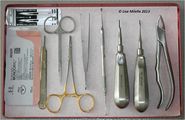
Tooth extraction kit
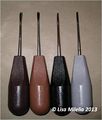
Selection of dental luxators
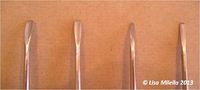
Dental luxator tips
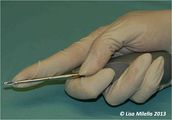
Correct grip for using a luxator
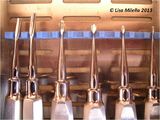
Selection of dental elevators
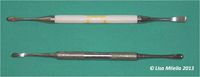
Examples of periosteal elevators
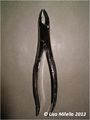
Tooth extraction forceps
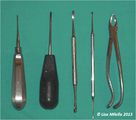
Feline tooth extraction kit


 |
This article was written by Lisa Milella BVSc DipEVDC MRCVS. Date reviewed: 13 August 2014 |
| Endorsed by WALTHAM®, a leading authority in companion animal nutrition and wellbeing for over 50 years and the science institute for Mars Petcare. | 
|